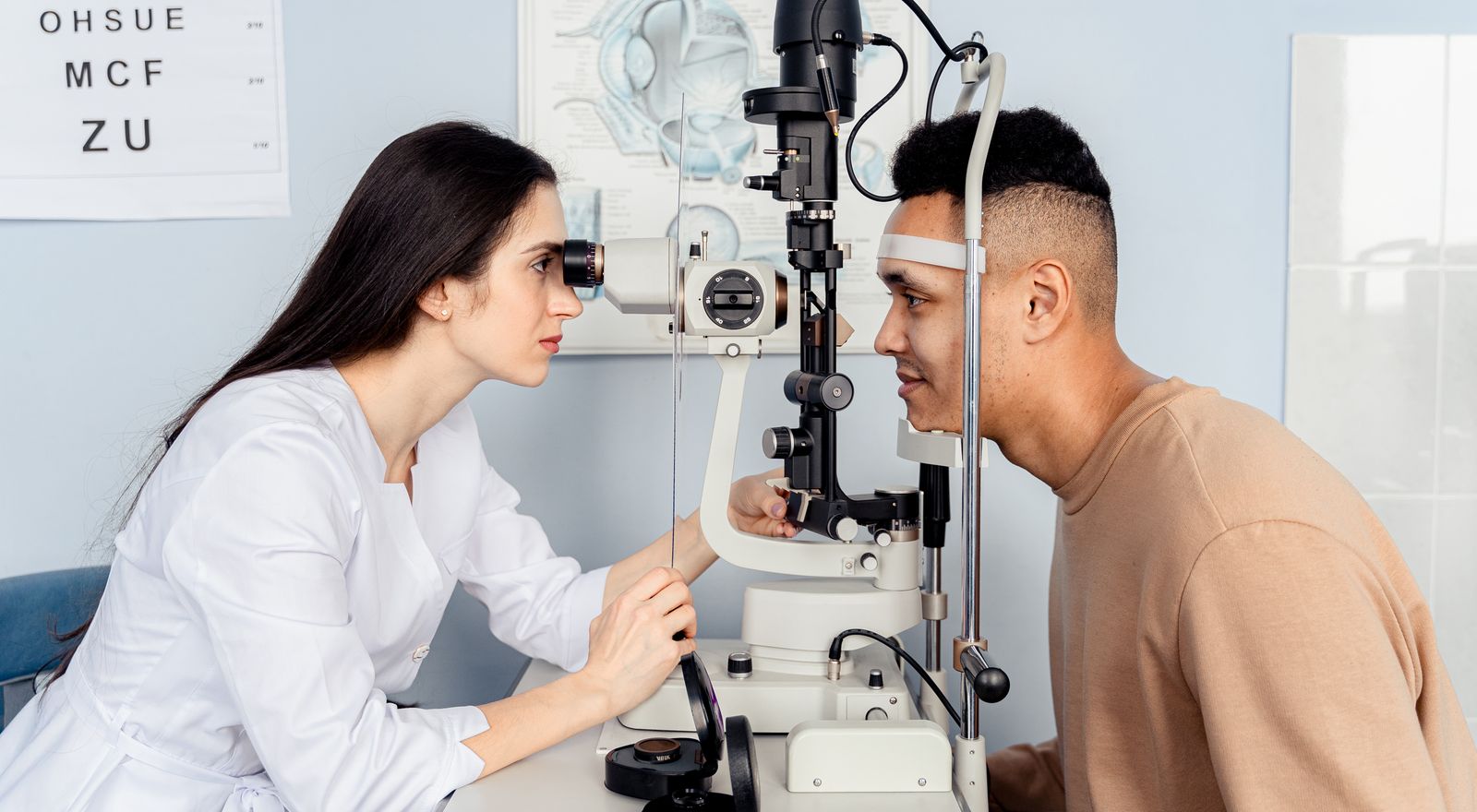
Scribing grew up in ophthalmology and emergency medicine, so optometrists reasonably ask whether it translates to their world — where a Tuesday might hold routine refractions, a red eye, two diabetic exams, and a contact lens fitting. The answer is yes, with optometry-specific contours worth understanding before you commit.
A dedicated virtual scribe for optometry and ophthalmology can take documentation off the doctor's plate during the exam.
Routine exams versus medical visits
The scribing value in optometry splits cleanly by visit type. Routine wellness exams are template-driven and quick to document; some ODs handle those notes efficiently themselves and wouldn't miss the typing. Medical visits are where documentation drags — the dry eye workup, the glaucoma evaluation with fields and OCT to reference, the diabetic exam with a letter owed to the PCP, the red eye that needs a careful history. Those notes carry narrative weight, coding implications, and follow-up plans, and they're what keeps ODs charting at home.
Practices structure around this in two ways. Some assign the scribe to medical visits only, letting the doctor run routine exams solo. Others give the scribe everything, reasoning — correctly, in high-volume offices — that even two saved minutes per routine exam compounds across twenty exams a day. Your medical-to-routine mix is the deciding variable, and it's worth actually counting before you size the role.
What changes in your lanes
Mechanically, little: a secure audio connection in the exam room, a scribe following in your EHR, and your findings verbalized as you go. What changes is rhythm. You stop pivoting to the keyboard after the slit lamp. You summarize the plan out loud to the patient — which the scribe captures, and which, ODs consistently notice, patients understand better because it was said to them rather than typed near them. The note is waiting for review by the time you reach the next lane.
ODs who dispense heavily notice a second-order effect: exams end on schedule more often, so the optical handoff happens while the patient is still unhurried. Nobody buys a second pair while worried about their parking meter.
The first month, honestly
Weeks one and two run slower than your baseline. The scribe is learning your phrasing, your template order, and how you signal that the exam portion has begun; you're learning to say findings you've silently typed for fifteen years. Expect to correct notes, and expect the corrections to shrink fast if you give specific feedback ("always record IOP with time and method" beats "be more thorough").
By weeks three and four, most OD-scribe pairs hit their stride: notes substantially complete at visit end, review taking a minute or two, corrections rare. If you're still heavily editing at week six, the fit or the training is wrong — say so to your provider, because that's what their replacement and retraining commitments exist for.
The questions ODs ask us most
"Will the scribe know optometry, or will I be teaching vocabulary?" Ask your provider precisely this. Scribes with eye care training document a slit-lamp exam at conversation speed; general medical scribes need weeks of vocabulary they should have arrived with. It's the single most important vetting question for this role.
"What about my routine-exam-heavy schedule?" If your book is overwhelmingly wellness exams with light documentation, a scribe may return less than an administrative VA working your recall list and phones. We'd rather tell you that now than after you've hired the wrong role. The practices where scribes shine are the ones building their medical side.
"Does the patient mind?" Rarely, in practice. A one-line introduction normalizes it, and the visible payoff — a doctor who never turns their back to type — reads as attentiveness, not surveillance.
Sizing the decision
Count three things from your last full week: medical visits, minutes spent charting after the last patient left, and notes closed later than the day of service. If the first number is substantial and either of the others makes you wince, remote scribing will likely pay for itself in recovered time alone — before counting the additional patients that recovered time can hold. If the numbers are modest, bookmark this and look again as your medical volume grows. Either way, you'll be deciding from your own arithmetic instead of someone's brochure, which is how staffing decisions ought to be made.